
Memphis homeowners need to protect their home electrical systems now because xAI’s Colossus supercomputer is placing unprecedented demand on the MLGW grid – and voltage fluctuations from grid stress silently damage HVAC systems, wiring, and appliances in homes that lack surge protection or have aging panels.
xAI has won TVA approval for 300 megawatts of power from MLGW – enough to supply roughly 60,000 homes – and a second Colossus facility is already under construction. xAI’s long-term target of 1,500 megawatts by 2030 represents roughly one-third of Memphis’s current peak demand of 4,500 MW.

xAI uses Tesla Megapacks to buffer the residential grid – but every Memphis homeowner in Germantown, Cordova, Bartlett, Collierville, or the city itself should know exactly what this means for the wiring inside their walls, and what to do about it before this summer’s peak season
Key Takeaways
| Fact | Why It Matters |
|---|---|
| xAI draws 300MW from MLGW’s grid – and growing | Peak summer demand is ~3,000 MW; even 300 MW strains the grid and required a second substation |
| Most Memphis homes were built before 1990 | Pre-1990 panels were designed for a fraction of today’s electrical load |
| Whole-home surge protection costs $300-$800 installed | One unprotected spike destroys an HVAC control board worth $1,500+ |
| Repeating breaker trips in summer are a warning | Overloaded circuits are a leading cause of residential fires |
| Federal Pacific and Zinsco panels are a fire risk | Tens of thousands of Memphis homes still have them |
| Aluminum branch wiring was standard 1965-1973 | 50 years of thermal cycling loosens connections invisibly |
What Is Actually Happening to the Memphis Electrical Grid in 2026?
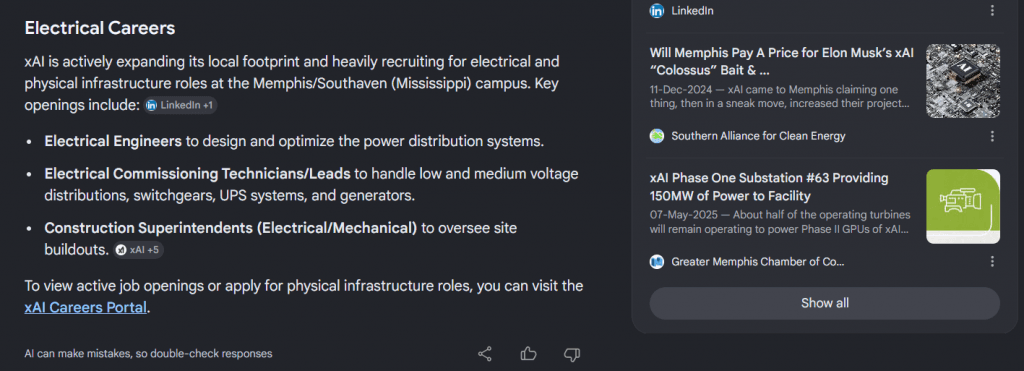
Memphis is experiencing the most significant shift in electrical demand in its modern history, and most homeowners have no idea. xAI’s Colossus facility opened in southwest Memphis with an initial demand of 150 MW – equivalent to approximately 100,000 homes – and that has since doubled to 300 MW. MLGW’s CEO confirmed in early 2026 that even 300 MW combined strains the grid, requiring a second substation. Fortune 500 tech firms including Nvidia and Dell are establishing Memphis operations in the same wave.
This matters to homeowners because a grid being asked to grow at an unprecedented pace is a grid under stress. Switching events, substation upgrades, and load-balancing operations create transient voltage fluctuations that damage home electronics, HVAC systems, and aging wiring silently over time.
Memphis Councilwoman Yolanda Cooper-Sutton has stated publicly, “We can’t get good electricity on a good day” – and that was before a facility demanding 10% of summer peak capacity moved in.
Does xAI’s Colossus Supercomputer Directly Affect My Memphis Home’s Power?
The answer has an important nuance.
xAI’s general manager confirmed the company isolates itself from the MLGW grid holistically using Tesla Megapacks, specifically to prevent any negative grid impact. So xAI is not directly pulling from your outlet. However, the infrastructure changes required to serve that demand – new substations, transmission upgrades, load-balancing events – reach every MLGW residential customer.
The 2022 blackouts and boil water advisories already highlighted the fragility of Memphis’s existing utility system, and that system is now absorbing the most power-hungry AI data center in the country.
The practical answer: don’t rely on the grid to be stable. Make your home’s electrical system resilient enough that fluctuations don’t matter.
How Grid Stress Damages Your Home’s Electrical System
Your home receives 120V/240V from MLGW, but voltage fluctuates constantly – especially during peak demand or switching events. During grid stress, voltage can briefly spike above 130V or sag to 100V. Your wiring handles these swings by heating up. On aged insulation common in pre-1985 Memphis homes, that thermal cycling degrades the protective coating around conductors, increasing fire risk silently over months.
The appliances most damaged by voltage fluctuation in Memphis homes:
- HVAC control boards – one 150V spike destroys the microelectronics brain of your AC ($600-$1,500 to replace)
- Smart appliances and refrigerators – inverter boards fail from repeated under/overvoltage cycling
- EV chargers – Level 2 units draw 30-50 amps; onboard electronics are vulnerable to transients
- Home office equipment – computers, monitors, and networking gear are particularly sensitive
Warning signs your home is already experiencing this:
- Lights dimming when the AC kicks on
- Breakers tripping on hot summer afternoons (3-7 PM peak)
- Electronics randomly resetting or failing early
- Outlet covers that feel warm to the touch
Memphis Home Electrical Systems by Era: What You Have and What You Need
Thirty years ago, the average Memphis home ran on 60-amp fuse service. Today the standard is 200 amps with up to 40 circuit breakers. The gap between those two realities is where danger lives.
| Home Era | Panel | Wiring | Risk Level Today |
|---|---|---|---|
| Pre-1960 | 60-amp fuse box | Knob-and-tube | Critical – major upgrade needed |
| 1960-1973 | 100-amp | Aluminum branch | High – connections loosen after 50 years |
| 1974-1989 | 100-amp | Copper romex | Medium-High – undersized for modern load |
| 1990-2005 | 100-150 amp | Copper romex | Medium – review before adding EV or solar |
| 2006-present | 200 amp | Copper + AFCI/GFCI | Low – maintain surge protection |
Memphis neighborhoods like Midtown, Whitehaven, Frayser, Raleigh, and older Cordova streets are heavily concentrated in the 1960-1989 bracket. If your home falls there, the question is not whether your electrical system needs attention – it is which upgrade to prioritize first.
5 Steps to Protect Your Memphis Home’s Electrical System Right Now
Step 1: Get a panel inspection. If your panel is over 20 years old or is a Federal Pacific Stab-Lok or Zinsco brand, start here. These panels have documented design flaws and high failure rates – often failing to trip during a fault – creating serious fire hazards. Insurance companies may deny claims on homes still running them. An inspection costs $150-$300 and tells you exactly where you stand.
Step 2: Install a whole-home surge protector. The single highest-value action Memphis homeowners can take right now. A Type 2 SPD installed at the main panel protects every circuit in your home from transient spikes. Whole-home surge protection costs $300-$1,000 installed – a fraction of replacing an HVAC control board after one unprotected event. Point-of-use strips do not protect against grid switching transients.
Step 3: Address aluminum branch wiring. Aluminum wiring was standard in Memphis homes built 1965-1973. After 50 years of thermal cycling, connections at outlets and the panel loosen. CPSC guidelines recommend evaluation and either co-rated device retrofits or copper pigtailing at every connection point.
Step 4: Add dedicated circuits for high-draw appliances. Your AC, refrigerator, washer, and EV charger should each run on their own dedicated circuit. Today’s AC systems consume more power than an entire home did 30 years ago, and sharing circuits between high-draw appliances puts chronic thermal stress on wiring insulation that is invisible until it faults.
Step 5: Upgrade to 200-amp service if you’re below it and adding load. If you are adding an EV charger, second AC zone, or home office circuits, a 100-amp panel is the wrong foundation. Panel upgrade costs in Memphis typically run $850-$4,000 depending on amperage – a fraction of what a single electrical fire costs, and required before most permits and utility upgrades.
DIY vs. Call a Pro: Decision Framework for Memphis Homeowners
| Situation | First Action | Estimated Cost |
|---|---|---|
| Pre-1974 home, unknown panel history | Panel inspection + Federal Pacific/Zinsco assessment | $150-$300 |
| Any home without surge protection | Whole-home SPD at main panel | $300-$800 |
| 100-amp panel + adding EV charger | Upgrade to 200-amp first | $1,500-$4,000 |
| Aluminum wiring (1965-1973 build) | Electrician evaluation + co-rated retrofit | $1,000-$4,000 |
| Breaker tripping repeatedly in summer | Circuit load analysis + dedicated circuit | $300-$700 per circuit |
Safe to DIY: Replacing outlet cover plates, swapping a light fixture with power off, resetting a tripped GFCI, changing to LED bulbs.
Call a licensed electrician: Any panel work, whole-home SPD installation, new circuit addition, aluminum wiring repair, EV charger installation, any work at the service entrance, any repeatedly tripping breaker.
What Most Memphis Homeowners Get Wrong About Electrical Protection
The $25 power strip is not protecting your appliances. Point-of-use strips contain a metal oxide varistor that absorbs small spikes once – then it is done, with no visible indicator it has failed. You believe your HVAC board is protected. It is not. The other costly mistake: treating a tripping breaker as an annoyance. A breaker trips because it detected an overload or fault. Repeatedly resetting it without investigation allows your wiring to overheat each time before the breaker catches it. That repeated thermal stress is how insulation fails inside walls, invisibly, until it does not.
FAQs
Does xAI’s Colossus supercomputer directly affect my Memphis home’s electricity?
Not directly – xAI isolates itself from the MLGW residential grid using Tesla Megapacks. But infrastructure upgrades and summer peak stress from serving xAI’s demand create transient voltage events that reach residential circuits. Whole-home surge protection is the right answer.
What are signs of voltage fluctuation in my Memphis home?
Flickering lights when the AC starts, breakers tripping on hot afternoons, electronics resetting randomly, and warm outlet covers. Any combination in a pre-1990 Memphis home warrants an electrician inspection.
How much does a whole-home surge protector cost in Memphis?
Typically $300-$1,000 installed, depending on panel type and device kA rating. Compare that to an HVAC control board replacement at $600-$1,500 and it is the easiest financial decision in home electrical safety.
Can my older Memphis home handle today’s electrical load?
Probably not without upgrades. Most homes today need at least 200 amps to function safely, and older 100-amp panels can struggle with modern electrical demands. If your panel was installed before 1990 and has never been evaluated, have a licensed electrician assess it.
What should I do if my breaker keeps tripping in Memphis summers?
Do not just reset it. Get it diagnosed before peak heat arrives. It may be a simple overloaded circuit needing a dedicated line – or aging wiring that needs immediate attention.
Is a 100-amp panel enough for a Memphis home today?
In most cases, no – especially running two AC units, a home office, or adding EV charging. The modern standard is 200 amps minimum, and even 100-amp panels can struggle with today’s loads. Upgrade the panel before adding significant new circuits.
The Bottom Line: What Every Memphis Homeowner Should Do Before Summer Peak
Memphis’s electrical grid is carrying more industrial load than at any point in the city’s history – and it will keep growing. The right response is not panic. It is one targeted action at a time, starting with the highest risk and highest value. If your home was built before 1990, schedule a panel inspection this month. If you have no whole-home surge protection, install one before June when MLGW peak demand hits 3,000 MW and grid switching events increase. If your panel is a Federal Pacific or Zinsco brand, treat that as urgent – not eventual.
The Memphis homeowners who will feel this grid shift most are the ones whose 1970s wiring and 100-amp panels were never designed for two AC units, a home office, and an EV charger running simultaneously. One voltage spike to an unprotected HVAC control board costs more than a whole-home surge protector installed today. One electrical fire in aging aluminum wiring costs everything.
Ace Electric serves Memphis, Germantown, Cordova, Bartlett, Collierville, and surrounding Shelby County communities. Licensed, insured, and locally operated.