
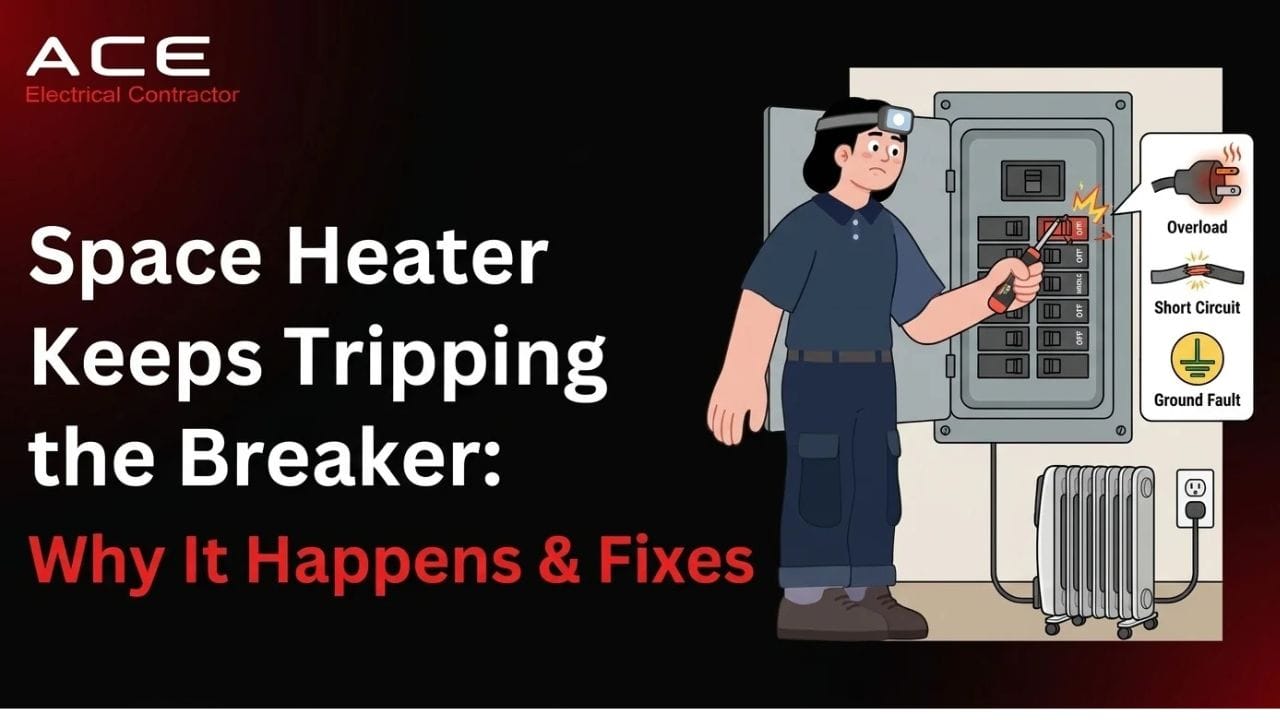
Your space heater keeps tripping the breaker because it asks an ordinary household circuit to carry almost everything it can. A 1,500-watt heater draws about 12.5 amps, and a 15-amp circuit is limited to 1,800 watts, so one more device on that circuit can push the load over the line. The breaker shuts off to protect the wiring behind the wall. Try the heater alone on its own circuit, or on a lower setting. If it still trips, or you need it every day, a dedicated circuit is the real fix. This guide covers the math, the safe checks, and when to call an electrician.
Key Takeaways
- A 1,500-watt heater draws about 12.5 amps. A 15-amp circuit is limited to 1,800 watts, and an electrician-reviewed guide advises staying near 1,440.
- The breaker is doing its job. It trips so the wiring does not overheat, so never tape, bypass, or defeat it.
- If your space heater keeps tripping the breaker, try it alone on a circuit, or on a lower setting, before assuming anything is broken.
- Plug a heater straight into the wall. The Illinois State Fire Marshal says never use an extension cord or surge protector, and MLGW says to avoid cords unless absolutely necessary.
- A plug that runs hot, or a GFCI that trips, is a different problem, and MLGW says to stop and have it checked.
- A device that draws more than half a circuit’s capacity should have its own circuit, which is what an electrician installs.
Why Does a Space Heater Keep Tripping the Breaker?
Because it is one of the heaviest loads you can plug into a normal outlet. A breaker exists to stop current before the wire inside the wall overheats. Family Handyman’s guide to preventing circuit overloads, which draws on a master electrician and a retired state chief electrical inspector, puts it plainly: breakers trip when demand exceeds capacity because that prevents overheated wires and possible fires.
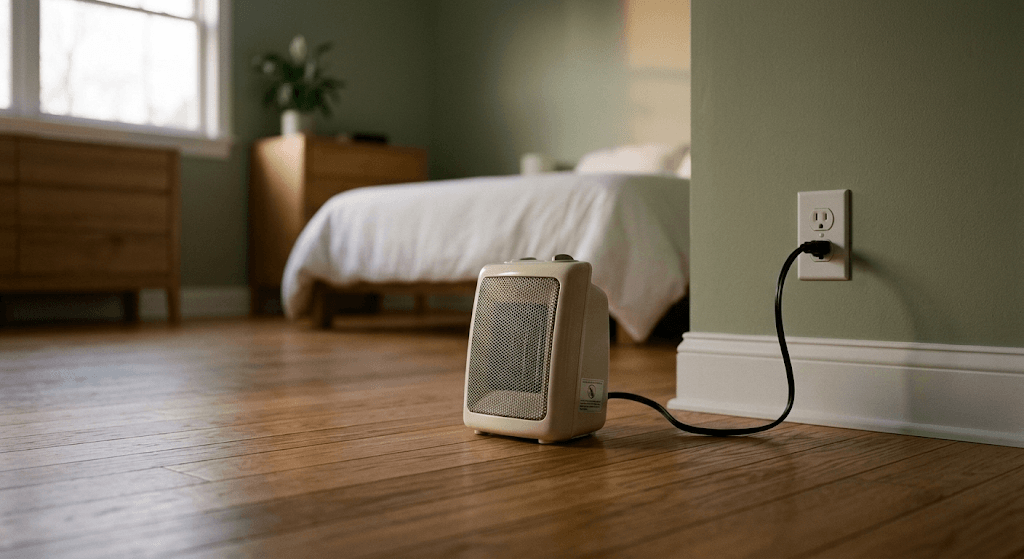
The math is short. Watts divided by volts gives amps, and a household outlet runs at 120 volts. The same guide gives 1,800 watts as the limit for a 15-amp circuit and recommends staying near 80 percent of that, or 1,440 watts.
How Common Heater Settings Load a 15-Amp Circuit
| Heater Setting | Draw at 120 Volts | Watts Left on an 1,800-Watt Circuit | Watts Left Under the 1,440-Watt Guideline |
|---|---|---|---|
| 1,500 watts (high) | 12.5 amps | 300 | None. Over by 60 |
| 1,000 watts | 8.3 amps | 800 | 440 |
| 750 watts (low) | 6.3 amps | 1,050 | 690 |
Check the label on your own heater, because settings vary by model. The point holds either way. On high, the heater alone sits above the guideline before anything else is plugged in.
Family Handyman’s breaker explainer, linked below, also notes that living rooms and bedrooms are more likely to be on 15-amp circuits, while kitchens and bathrooms are more likely to be on 20-amp ones. That is why a heater that behaves in one room can trip a breaker in another.
Why It Sometimes Trips After 10 or 20 Minutes
Overloads do not always trip a breaker right away. Family Handyman’s explanation of how circuit breakers work describes a strip of two bonded metals inside a standard breaker. It heats and bends as current stays high, and trips when it reaches a set limit.
A heater running near the limit can hold on for a while, then shut the circuit off once that strip gets hot enough. That delay makes the problem look random when it is not.
Is It the Circuit, the Heater, or the Breaker?
Most of the time it is the circuit. Use the table to match what you see to the likely cause before you change anything.
What Your Symptom Usually Means
| What You See | What It Likely Points To | Safe Next Step |
|---|---|---|
| Trips only when something else on the circuit runs | Shared circuit overloaded | Unplug other devices or move the heater to another circuit |
| Trips after 10 to 20 minutes on high, nothing else running | Sustained load near the circuit’s limit | Use a lower setting, or look at a dedicated circuit |
| Trips instantly, even on low and on different circuits | A possible fault in the heater | Stop using it and have it checked or replaced |
| Trips on one circuit but runs fine on another | The first circuit has a heavier load or a problem | Trace what is on it, and call an electrician if unclear |
| Plug or outlet feels hot | Loose plug or worn outlet | Unplug it and have the outlet checked |
| GFCI trips when the heater runs | Possible ground fault | Stop using the heater and have it checked |
MLGW’s winter safety reminder covers the last two. It says that if a plug feels hot, you should unplug the heater and have a qualified repairman check it, and if the heater and plug are fine, have the outlet replaced. It also says that if a GFCI trips under a heater, you should not assume the GFCI is broken, and should have the heater checked. If the outlet itself is the problem, Ace Electric’s outlet troubleshooting guide covers the common causes.
How Do You Check the Heater and Plug?
Do this with the heater unplugged and cool.
- Look at the cord and plug for cracks, fraying, or discoloration.
- Make sure the plug fits snugly in the outlet. MLGW notes that a loose plug can overheat.
- Run the heater briefly, then feel the plug and cord. MLGW says heaters draw a lot of power, so some warmth is normal. A hot plug means unplug the heater and have it checked.
- If the heater itself seems faulty, leave the repair to a qualified appliance service center. MLGW advises against repairing or adjusting its parts yourself.
What Should You Try First?
Work through these in order. They are all safe for a homeowner and need no tools.
- Turn the heater off, unplug it, and reset the breaker once. If it trips again quickly, stop resetting. Ace Electric’s emergency electrician guide explains why repeat resets are a mistake.
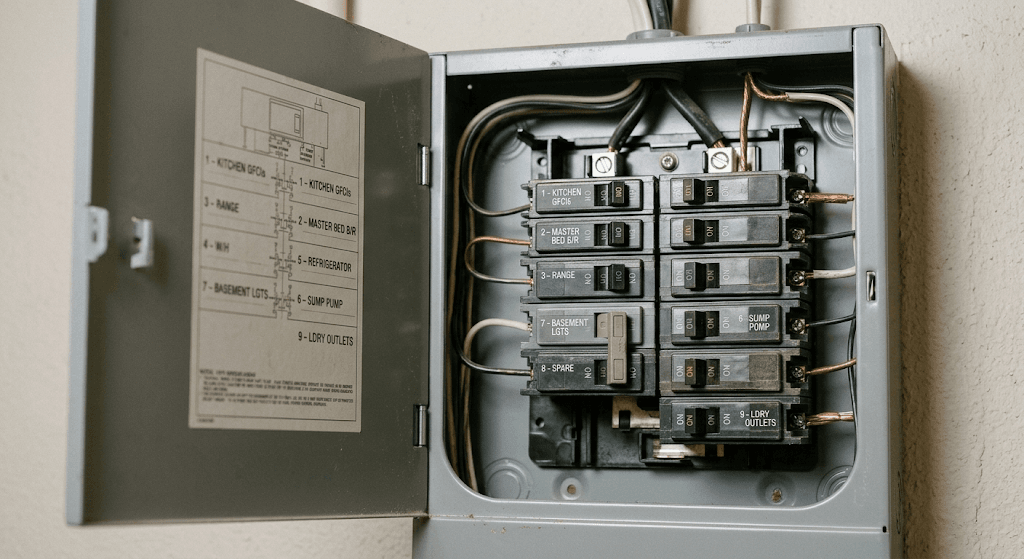
- Find out what else is on the circuit. Family Handyman suggests switching the breaker off, then walking through the house flipping lights and testing outlets. Check both halves of each duplex outlet, since they can be on different circuits.
- Unplug everything else on that circuit. Run the heater alone and see whether it holds.
- Drop to a lower setting. A lower setting draws fewer amps and leaves room on the circuit.
- Try a different circuit. Check what is on it first, so you do not simply move the overload.
- Plug directly into the wall. No power strip, no surge protector.
- Feel the plug and cord. If either runs hot, unplug the heater and have it looked at.
If the heater runs fine alone on another circuit, the original circuit was overloaded and you have your answer. If it still trips alone on every circuit, suspect the heater.
How Do You Map the Circuit and Add Up the Load?
A few minutes of detective work tells you whether a circuit can ever carry your heater. Family Handyman’s overload guide lays out the method.
- Switch the breaker off, then walk the house. Flip lights, test outlets, and check the top and bottom of each duplex outlet, because they can be wired to different circuits.
- Write down everything that went dead. A simple floor plan helps.
- Add up the wattage on that circuit. Bulbs are marked with their wattage, and devices that stay plugged in usually have a label on the back.
- Compare the total to the guideline. That is 1,440 watts for a 15-amp circuit and 1,920 for a 20-amp one.
Here is an example with made-up numbers. A 1,500-watt heater, a 200-watt TV, and a 100-watt lamp add up to 1,800 watts. That is the full limit of a 15-amp circuit and well over the 1,440-watt guideline. Remove the TV and lamp, and the heater alone is still above it. That is the situation where a dedicated circuit is worth serious thought.
One note on the method. Family Handyman’s own calculation leaves out devices that plug in only temporarily, such as vacuum cleaners. For a heater you plan to run, count it.
What Should You Never Do?
A few shortcuts turn a nuisance into a fire risk.
- Do not swap in a bigger breaker on your own. Family Handyman’s guide says it depends on the wire. A 15-amp circuit may be wired with 14-gauge wire, which cannot safely take a 20-amp breaker, while a 20-amp circuit needs thicker 12-gauge wire. The guide recommends a licensed electrician evaluate the circuit first. The breaker protects the wire, so making it bigger without checking the wire removes the protection.
- Do not use a power strip or surge protector. The Illinois State Fire Marshal says to plug a heater directly into an outlet and never use an extension cord or surge protector.
- Treat extension cords as a last resort. MLGW says to avoid them unless absolutely necessary, and if you must use one, it should be marked 14 or 12 gauge and carry an independent testing lab label.
- Do not hide the cord under a rug. MLGW warns that covering a cord can make it overheat.
- Do not leave a heater running unattended. The fire marshal’s guidance is to turn it off when you go to bed or leave the house.
Do You Need a Dedicated Circuit for a Space Heater?
A dedicated circuit may be a practical solution if you regularly operate a high-wattage space heater and the existing circuit cannot safely handle the additional load. A 1,500-watt heater draws approximately 12.5 amps at 120 volts, leaving little capacity for other devices on a 15-amp circuit. An electrician can evaluate the heater’s operating requirements, existing circuit loads, wiring, and panel capacity to determine whether a dedicated circuit is appropriate. This is a practical recommendation, not a universal NEC requirement based on a device drawing more than half a circuit’s capacity.
A dedicated circuit means one outlet on one breaker with nothing else sharing it. The heater gets the whole circuit, and the rest of the room’s devices stop competing with it.
When a Dedicated Circuit Makes Sense
| Situation | Reasonable Next Step |
|---|---|
| Occasional use, nothing else on the circuit, low setting works | A dedicated circuit may not be needed. Keep using it carefully |
| Heater trips only when other devices run | Redistribute devices, or add an outlet on a less loaded circuit |
| Heater is the main heat for a room, such as a garage, workshop, or sunroom | Ask an electrician about a dedicated circuit and whether the room needs a different heating solution |
| Plug or outlet runs warm or hot | Have the outlet checked and likely replaced first |
| Panel is full, old, or already near capacity | Get a panel assessment before adding anything |
What Does an Electrician Actually Do About It?
The job is less about the heater than about the circuit and the panel behind it. A typical visit covers these steps:
- Review the circuit’s loads. The electrician checks what else shares it and how much it carries.
- Match the wire and the breaker. The wire gauge decides which breaker is safe. Family Handyman notes that 15-amp circuits may be wired with 14-gauge wire while 20-amp circuits need 12-gauge.
- Check the panel’s capacity. The guide notes that, under NEC rules, the total load on a panel should not exceed 80 percent of its capacity. If a new circuit pushes past that, a panel upgrade comes first, and Ace Electric’s guide to electrical panel upgrade cost in Memphis explains that project.
- Install the circuit if it is justified. That means running a new line from the panel to where the heater will sit.
- Handle the permit. Adding a circuit alters the electrical system. The Memphis and Shelby County electrical code requires a permit before altering electrical systems and issues permits to licensed or registered contractors. You can read it in the county’s published electrical code.
That code covers the City of Memphis and unincorporated Shelby County. Other cities in the county may have their own code offices, so confirm the rules for yours before work starts.
What Moves the Price
| Factor | Why It Matters |
|---|---|
| Distance from the panel | A longer run takes more wire and more labor |
| Open breaker space | A full panel may need work before a new breaker fits |
| Wall and ceiling access | Fishing wire through finished walls takes longer than working in open framing |
| Where the outlet goes | A new outlet location can mean more cutting and patching |
| Outlet condition | A worn or hot outlet may need replacing too |
| Permit and inspection | Fees and scheduling add to cost and timeline |
This guide leaves out a dollar figure, because a number from another city would mislead you. Ask for an itemized quote that lists each of these.
How Do You Use a Space Heater Safely Once the Circuit Is Sorted?
Fixing the circuit solves the tripping. It does not make the heater itself safe. The Illinois State Fire Marshal, citing NFPA data for 2018 to 2022, reports that space heaters and heating stoves accounted for nearly half (46 percent) of home heating equipment fires, and about 76 percent of the deaths and 72 percent of the injuries from them.
Space Heater Safety Rules
| Rule | Why It Matters | Source |
|---|---|---|
| Keep the heater 3 feet from anything that can burn | Heat can ignite nearby fabric, furniture, or bedding | Illinois State Fire Marshal |
| Plug directly into the wall outlet | Heaters draw a lot of current, and cords and strips can overheat | Illinois State Fire Marshal, MLGW |
| Choose a unit with a tip-over shutoff and lab certification | The heater turns itself off if it falls | Illinois State Fire Marshal, MLGW |
| Put the heater on the floor, not furniture | A fall can break parts and cause a fire or shock hazard | MLGW |
| Keep it out of wet places such as bathrooms unless certified for it | Moisture can corrode parts and create a shock risk | MLGW |
| Never leave it on unattended or while you sleep | An unattended heater can overheat or ignite nearby items with no one there to react | Illinois State Fire Marshal |
| Check smoke and carbon monoxide detectors | They are the backup if something goes wrong | Illinois State Fire Marshal |
How Do You Choose an Electrician for This Job?
This is a small job with a few details that matter. Before you hire, confirm:
- License or registration. The county’s code defines an electrical contractor as one holding a license from the Office of Construction Code Enforcement, or a properly registered certified state contractor.
- An itemized written estimate. It should list the circuit run, wire size, breaker, outlet, and any panel work.
- A look at the whole circuit. A good electrician asks what else is on it and checks the panel, instead of just adding a line.
- Permit and inspection included. Ask who pulls the permit and who schedules the inspection.
- A check of the existing outlet. If it runs warm, MLGW’s guidance points to replacing it.
Frequently Asked Questions
Why does my space heater trip the breaker even on low?
Even a low setting draws several amps, and anything else on the circuit adds to it. Run the heater alone, then try it on a different circuit. If it trips alone on every circuit, the heater may have a fault.
Is it safe to keep resetting the breaker?
No. A breaker that keeps tripping is telling you the circuit is overloaded or something is wrong. Reset it once after you unplug the extra loads, and if it trips again, stop and call an electrician.
Can I plug a space heater into an extension cord or power strip?
The Illinois State Fire Marshal says never. MLGW says to avoid extension cords unless absolutely necessary, and then only a cord marked 14 or 12 gauge with a testing-lab label. The safest option is the wall outlet itself.
Will a 20-amp breaker fix it?
Not necessarily. Installing a larger breaker will not solve an overloaded circuit unless the entire circuit is suitable for the higher rating. The wire gauge, wiring configuration, outlet ratings, and other circuit components must all be evaluated. Never replace a 15-amp breaker with a 20-amp breaker simply to stop repeated tripping. Have a licensed electrician determine whether the circuit needs repair, a properly sized upgrade, or a new dedicated line.
Do I need a dedicated circuit for a space heater?
Family Handyman’s guidance is that anything drawing more than half a circuit’s allowed maximum should have its own circuit. A 1,500-watt heater exceeds that on a 15-amp circuit. If you run the heater regularly, a dedicated circuit is worth discussing with an electrician.
Why is my heater’s plug or outlet warm?
MLGW notes that heaters draw a lot of power, so the cord and plug can feel warm. If the plug feels hot, unplug the heater and have it checked. If the heater and plug are fine, MLGW says to have the outlet replaced, since a loose fit can overheat.
Final Word
When a space heater keeps tripping the breaker, the heater is rarely the problem. It is usually a normal heater on a circuit that was never meant to carry it alongside everything else in the room. The checks are simple, and the right fix, when you need one, is a circuit for the heater and nothing else.
If your space heater keeps tripping the breaker and you want an electrician to look at the circuit, add a dedicated line, or check an outlet that runs warm, Ace Electric provides residential electrical work across Shelby County. You can reach the team at (901) 870-3298.
Curated by Ace Electric,
Your trusted electricians in Tennessee.