
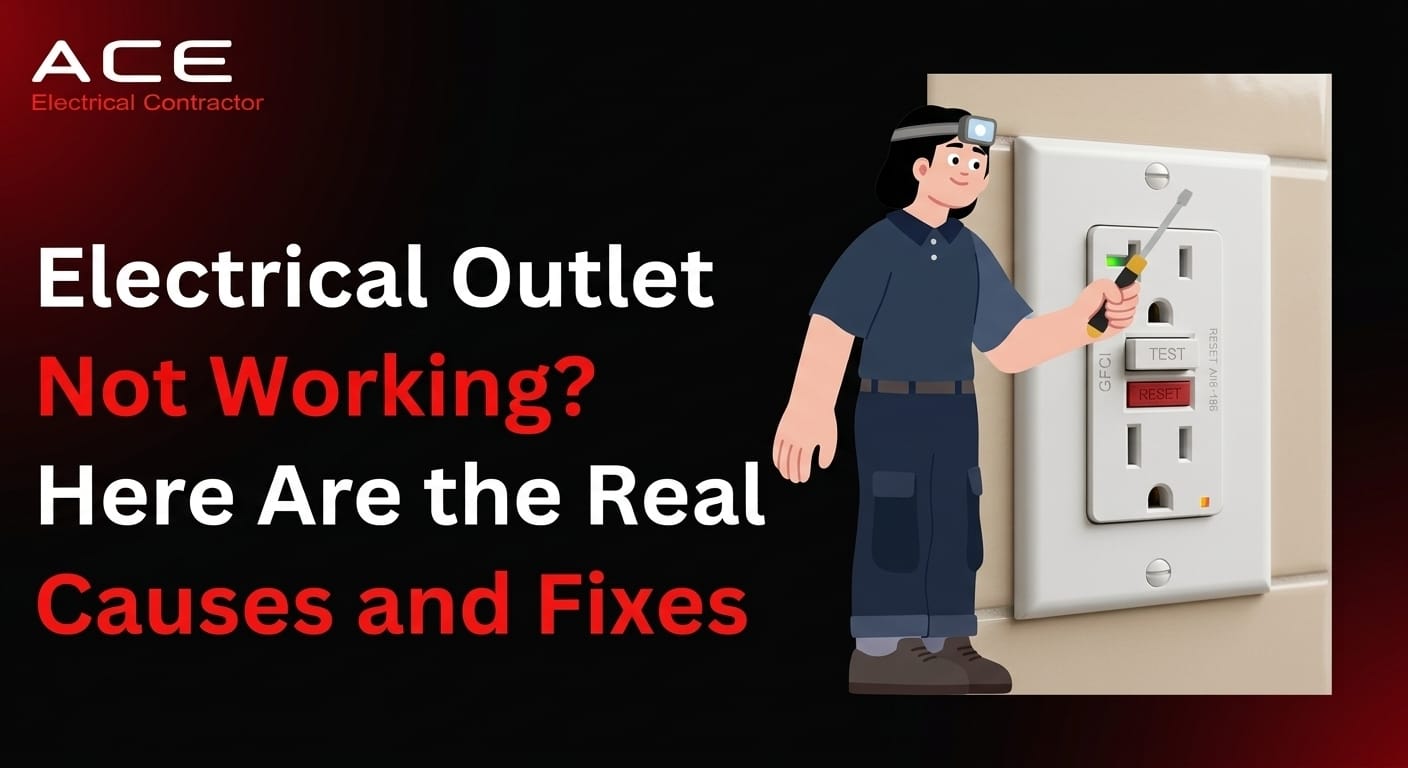
An electrical outlet not working because of one of five specific causes: a tripped GFCI outlet cutting power to downstream outlets, a tripped or faulty circuit breaker, a loose or failed wire connection inside the outlet box, a backstab connector that has finally released, or a failed outlet device that needs replacement. In Memphis homes built before 1990, a tripped GFCI protecting hidden downstream circuits is the most common cause, and the most missed. This guide covers every cause in order of likelihood, how to safely check each one, what is DIY-safe, and what requires a licensed electrician.
Key Takeaways
- The most common reason an outlet stops working is a tripped GFCI located somewhere else on the same circuit, often in the bathroom, garage, or kitchen
- If the breaker looks fine and no GFCI has tripped, the fault is inside the outlet box itself, a loose wire, failed backstab connection, or dead outlet device
- Half an outlet working (top working, bottom dead or reversed) points to a switch-controlled bottom outlet or a failed internal tab, not a circuit problem
- Multiple outlets dead on the same wall usually share a circuit, one failed outlet upstream can cut power to everything downstream
- Outlet repair in Memphis costs $75 to $200 for a single outlet, considerably less than the appliance damage an ignored loose connection can cause over time
- Any outlet that sparks, feels warm, or smells burnt is not a troubleshooting situation, it is a licensed electrician call today
Why Is My Electrical Outlet Not Working? The 5 Real Causes
When an outlet goes dead, homeowners tend to go straight to the breaker box. That is the right instinct but not always the right answer. Only about 30 percent of dead outlets in Memphis homes trace back to a tripped breaker. The majority come from a tripped GFCI somewhere else on the circuit, a loose internal connection, or an outlet that has simply failed. Understanding the order of likelihood saves time and avoids unnecessary panel work.
The 5 Causes of a Dead Outlet, Ranked by Frequency
| Cause | How Common | DIY Fix? | Electrician Needed? |
|---|---|---|---|
| Tripped GFCI outlet on the same circuit | Very common, especially pre-1990 homes | YES, reset the GFCI | Only if GFCI won’t reset |
| Tripped circuit breaker | Common | YES, reset the breaker once | YES, if it trips again immediately |
| Loose wire connection inside outlet | Common in older Memphis homes | NO, live wire exposure | YES |
| Backstab connection failure | Common, homes with push-in outlets | NO | YES |
| Failed outlet device | Less common | Possibly, if experienced | YES in most cases |
Is It a Tripped GFCI? How to Find and Reset It
A tripped GFCI outlet is the single most overlooked cause of a dead outlet in any American home, and Memphis homes built before 1990 make it even more confusing. Builders wired GFCI outlets to protect multiple downstream outlets on the same circuit, which means a GFCI in your bathroom can control an outlet in your bedroom, hallway, or even garage without any visible connection between them. When the GFCI trips, from a surge, moisture, or overload, every outlet downstream goes dead instantly. The only fix is finding and resetting the source GFCI, not the dead outlet itself.
How to find the tripped GFCI:
- Check every GFCI outlet in the house, look for ones where the TEST button is popped out slightly or the RESET button is sitting flush without any resistance when pressed
- Start in bathrooms, then garages, then kitchens, then outdoor outlets, these are the most common GFCI source locations
- Press the RESET button firmly until you feel or hear a click
- Go back to the original dead outlet and test it
- If it still doesn’t work, look for another GFCI, circuits can chain through multiple rooms
Memphis Pre-1990 Housing Note: Homes in Midtown, Whitehaven, Cordova, and other Memphis neighborhoods built between 1960 and 1990 often have GFCI outlets in unexpected locations, sometimes in closets, utility rooms, or even one bathroom controlling outlets in a completely separate part of the house. If you cannot find the tripped GFCI, an electrician can trace the circuit in under an hour.
For full details on GFCI requirements by room and what Memphis code requires, see Ace Electric’s guide on GFCI outlet installation in Memphis.
Could It Be a Tripped Circuit Breaker, Even If It Looks Fine?
A tripped breaker does not always look tripped. That is the part most homeowners miss. A breaker in the mid-position, neither fully on nor fully off, has tripped internally but the switch has not moved all the way to the off position. It looks on. It is not. If you look at your panel and see a breaker that is slightly out of line with the others, that is your culprit.
How to properly reset a tripped breaker:
- Locate the breaker panel, usually in a utility room, hallway, or garage
- Look for any breaker that appears slightly out of alignment with the others
- Switch it completely off first, you will feel resistance
- Then switch it fully on, firm pressure until it clicks
- Go back to the outlet and test it
If the breaker trips again immediately after reset, do not reset it a second time. A breaker that trips instantly is detecting a real fault, a short circuit, overloaded circuit, or wiring problem. That requires an electrician, not another reset attempt.
When the breaker is genuinely the problem: An aging breaker can fail internally and stop supplying power even without tripping visibly. Breakers in Memphis homes built in the 1970s and 1980s are now 40 to 50 years old. A faulty breaker costs $100 to $250 to replace and is a licensed electrician job, panel work is never DIY territory.
Outlet Stopped Working, But Breaker Is Fine, What Now?
This is where most homeowners get stuck. The breaker is on, no GFCI has tripped, but the outlet is still completely dead. The cause is inside the outlet box. There are three possibilities: a loose wire connection that has separated over time, a failed backstab (push-in) connector that has lost its grip, or a dead outlet device that needs replacing. All three require opening the outlet box, which means touching live wiring if done incorrectly.
Signs the problem is inside the outlet:
- Only that one outlet is dead, nothing else on the circuit is affected
- The outlet worked intermittently before going completely dead
- The outlet is in an older Memphis home with push-in backstab connectors (very common in 1970s–1990s construction)
- The outlet box feels slightly warm to the touch
What happens inside a failed backstab connection: Push-in connectors grip the wire with a spring clip. Over time, that clip loses tension, especially in homes where outlets have been plugged and unplugged thousands of times. When the clip lets go, the wire pulls back slightly and the connection fails. The fix is replacing the outlet with a proper screw-terminal connection, which holds permanently.
This is not a safe DIY repair in most cases. The outlet box contains live wires even when the breaker for that circuit is switched off, if the neutral is shared or a backfed circuit is present. A licensed electrician replaces a failed outlet in 20 to 30 minutes.
Why Are Multiple Outlets Not Working on the Same Wall?
Multiple dead outlets in the same area almost always share a circuit. When one outlet’s wiring connection fails, every outlet downstream loses power simultaneously. They look unrelated but they are part of the same daisy-chain.
How to identify the upstream fault:
- Find the outlet closest to the panel among the dead ones, that connection is the most likely break point
- Check if a GFCI sits between those outlets and the panel
- Multi-room outages point to a panel circuit issue rather than a single outlet failure
In Memphis homes built before 1985, 10 to 15 outlets on one 15-amp circuit with backstab connections is common. One failed connection kills the whole run.
Half My Outlet Is Not Working, What Does That Mean?
A half-dead outlet, where the top plug works but the bottom does not, or one side has power and the other does not, is a different problem from a completely dead outlet. It is not a circuit issue. It is either a switch-controlled outlet or a failed internal tab.
Half Outlet Not Working: Two Causes
| Situation | What It Means | Fix |
|---|---|---|
| Bottom outlet controlled by a wall switch | Builder wired it intentionally for a lamp | Flip the light switch in the room |
| Top works, bottom completely dead (no switch) | Internal tab between outlets is broken | Replace the outlet |
| One prong slot has power, other does not | Failed hot or neutral connection | Electrician, wiring issue |
Switch-controlled outlets are extremely common in Memphis living rooms and bedrooms built before 2000. Builders wired the bottom outlet to a wall switch so a floor lamp could be turned on at the door. If you have a dead bottom outlet and a wall switch that does not appear to control anything, that switch is controlling the outlet.
Decision Framework: Reset, Replace, or Call an Electrician?
Before picking up the phone or a screwdriver, run through this framework. It takes two minutes and will tell you exactly what level of action the situation calls for.
Outlet Troubleshooting Decision Framework
| What You Observe | Likely Cause | Safe Action | Urgency |
|---|---|---|---|
| Outlet dead, GFCI found tripped nearby | Tripped GFCI | Reset GFCI | Low, self-fixable |
| Outlet dead, breaker slightly off-center | Tripped breaker | Reset breaker (once only) | Low, self-fixable |
| Outlet dead, breaker trips again on reset | Short circuit or overload | Do not reset, call electrician | Medium, within 24 hrs |
| Outlet dead, no tripped GFCI, breaker fine | Failed connection or outlet | Call electrician | Medium, within 48 hrs |
| Multiple outlets dead, same wall or room | Upstream connection failure | Call electrician | Medium, within 48 hrs |
| Half outlet dead, no switch in room | Failed internal tab | Call electrician | Low, schedule when ready |
| Outlet sparks, smells burnt, or feels warm | Active wiring fault | Do not use, call electrician today | HIGH, same day |
| Any shock, even mild tingle, from outlet | Grounding or wiring failure | Stop using, call electrician now | EMERGENCY |
How Much Does Outlet Repair Cost in Memphis?
Outlet repair in Memphis is among the most affordable electrical service calls a homeowner makes. The work is fast, the materials are cheap, and most repairs resolve in a single visit. According to local project data from Memphis electrical service providers, most single-outlet repairs land between $75 and $200 depending on the cause. HomeGuide: Memphis Electrical Repair Costs
Outlet Repair Cost Breakdown: Memphis, TN (2026)
| Repair Type | Cost Range | Time Required |
|---|---|---|
| Diagnose and reset tripped GFCI or breaker | $0 (DIY) | 5 minutes |
| Replace single failed outlet | $75 – $150 | 20–30 min electrician |
| Replace backstab outlet with screw-terminal | $100 – $175 per outlet | 30–45 min electrician |
| Repair loose wire connection inside outlet box | $100 – $200 | 30–60 min electrician |
| Trace and repair upstream connection failure (multiple dead outlets) | $150 – $350 | 1–2 hrs electrician |
| Replace faulty circuit breaker at panel | $100 – $250 | 1 hr electrician |
For homes where repeated outlet failures trace back to an aging or undersized panel, see Ace Electric’s local breakdown of electrical panel upgrade cost in Memphis.
The International Association of Electrical Inspectors notes that delayed repair of failed outlet connections significantly increases fire risk in residential settings, particularly in homes with aluminum wiring or backstab connectors common in pre-1990 construction. International Association of Electrical Inspectors
When an Outlet Not Working Is an Emergency
Most dead outlets are a nuisance, not a crisis. Call a licensed electrician the same day if:
- The outlet or wall plate is warm or hot to the touch
- You smell burning plastic near the outlet or panel
- The outlet sparked before going dead
- You received any shock or tingle, even mild
- Scorch marks or discoloration are visible on the outlet face
- The outlet went dead after water exposure in a bathroom or kitchen
An outlet generating heat is not safe to leave unaddressed overnight.
Frequently Asked Questions
Why is my electrical outlet not working even though the breaker is not tripped?
The most common cause is a tripped GFCI outlet somewhere else on the same circuit, often in a bathroom, garage, or kitchen, cutting power to the dead outlet. If no GFCI has tripped, the fault is inside the outlet box: a loose wire connection, a failed backstab connector, or a dead outlet device. None of these trigger a breaker because they are not current faults, they are connection failures.
How do I reset a GFCI outlet that controls other outlets?
Find the GFCI outlet on that circuit, usually in a bathroom, kitchen, or garage, and press the RESET button firmly until you feel a click. If the button will not stay pressed, the GFCI has detected an ongoing fault and is refusing to reset. In that case, the circuit has a real problem that needs a licensed electrician to diagnose.
Can a dead outlet be a fire hazard?
Yes, if the cause is a loose or arcing connection rather than a simple trip. A loose wire that intermittently carries current generates heat at the contact point each time it does. That heat builds over time and can ignite surrounding insulation. Any outlet that was warm, sparking, or smelling before it went dead should be treated as a potential fire hazard and inspected immediately.
How much does it cost to fix a dead outlet in Memphis?
Most single-outlet repairs in Memphis cost $75 to $200 including labor. Tracing and repairing an upstream connection failure affecting multiple outlets runs $150 to $350. Replacing a faulty circuit breaker at the panel costs $100 to $250. These are among the lower-cost residential electrical repairs.
Why are half of my outlets dead on the same wall?
Half the outlets on a wall are usually dead because one outlet upstream in the circuit has a failed connection, cutting power to every outlet downstream from that point. The break is typically at the outlet closest to the breaker panel among the dead ones. An electrician traces the circuit, identifies the failed connection, and restores power to the full run in one visit.
Is a dead outlet something I can fix myself?
Resetting a tripped GFCI or a tripped breaker is safe for most homeowners. Any work that involves opening an outlet box, touching wiring, or accessing the panel requires a licensed electrician in Tennessee. Unpermitted wiring work on new outlet installations creates liability at home sale and can void homeowner’s insurance if later found non-compliant.
Final Word
A dead outlet almost always has a straightforward cause. Work through the checklist first, tripped GFCI, tripped breaker, switch-controlled outlet. Most homeowners find the answer in under five minutes. If those checks produce nothing, the fault is inside the outlet box and it is time to call a licensed electrician.
The repair is fast and inexpensive. What makes it worth addressing promptly is what a failed connection does over time, building heat at the contact point, degrading insulation, and creating the conditions for a more serious fault.
For licensed outlet repair and electrical diagnostics across Shelby County, Ace Electric serves Memphis, Germantown, Bartlett, Collierville, Cordova, and Millington.
Curated by Ace Electric,
Your trusted electricians in Tennessee.