
Basement electrical wiring costs between $800 and $5,000 depending on whether the space is unfinished or being fully converted into a livable room. A basic circuit and outlet installation for an unfinished utility basement runs $800 to $1,500. A full finished basement with lighting, dedicated circuits, a home theater setup, and code-required GFCI and AFCI protection typically lands between $2,500 and $5,000. Memphis homes built before 1980 often need a panel assessment before any basement wiring begins, since the added circuits draw significantly more load than most 100-amp panels can support. This guide covers real cost ranges, code requirements, what the permit process looks like, and how to scope your project correctly before calling anyone.
Key Takeaways
- Basement electrical wiring in Memphis costs $800 to $5,000, basic utility circuits sit at the low end; a fully finished entertainment space with theater, home office, and bedroom circuits sits at the high end
- NEC requires GFCI protection on all outlets in unfinished basements, and AFCI protection in any finished habitable basement space
- Memphis homes built before 1980 commonly run 100-amp panels, adding 8 to 15 basement circuits may exceed panel capacity and require an upgrade first
- Every new circuit installation in a Memphis basement requires a permit through Shelby County Code Enforcement, the inspection confirms code compliance before any wall is closed up
- Labor runs $85 to $120 per hour in Memphis, plan for 10 to 30 hours depending on scope
- Scoping the circuit layout before drywall goes up is the single most important step, rewiring inside finished walls costs 3 to 4 times more than running wire through open framing
What Does Basement Electrical Wiring Actually Include?
“Wiring a basement” means different things depending on how the space is being used. A utility basement with a sump pump and a few work lights needs far less than a finished entertainment space with four rooms, a wet bar, a home theater, and a guest bedroom.
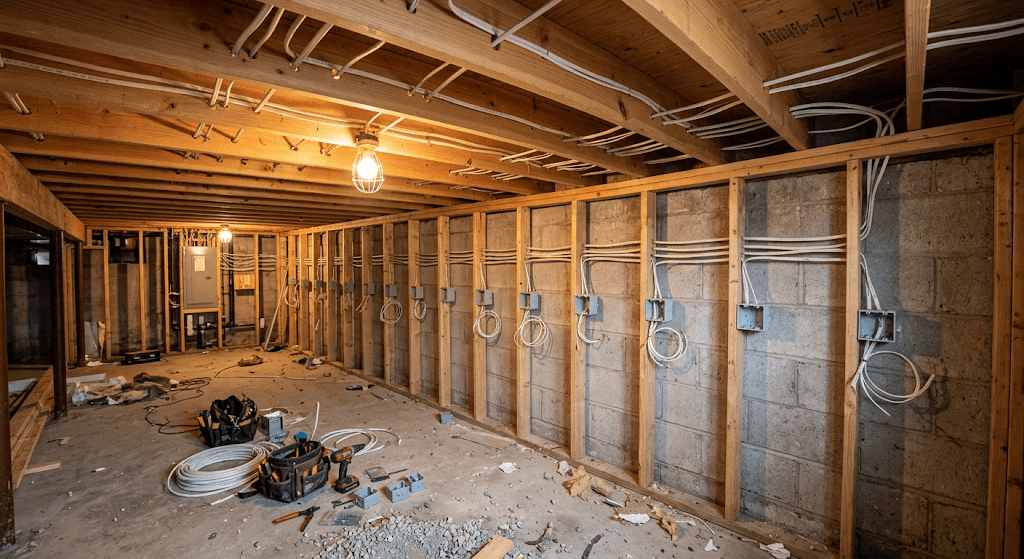
Understanding what goes into each scope prevents the budget gaps that come from only quoting one part of the project.
What’s Typically Included in Basement Electrical Wiring
| Component | Purpose | Required? |
|---|---|---|
| New circuits from panel | Powers all basement loads | YES, every circuit needs its own breaker |
| 15A or 20A branch circuits | General outlets and lighting | YES |
| GFCI outlets | Required near water and in unfinished spaces | YES, NEC code |
| AFCI breakers | Required in finished habitable rooms | YES, NEC 210.12 |
| Recessed lighting wiring | Ceiling lighting in finished rooms | For finished spaces |
| Dedicated circuits | Appliances, home theater, EV charger | When high-draw devices are present |
| Panel capacity assessment | Confirms existing service can handle load | Always recommended |
| Permit and inspection | Code compliance sign-off | YES, required in Memphis |
| Conduit (where exposed) | Protects wiring in unfinished utility areas | As needed by code |
Each component adds to the total. A homeowner who asks for a quote on “wiring the basement” without defining the scope often receives a number that does not include half of what the project actually requires.
How Much Does Basement Electrical Wiring Cost in Memphis?
Cost varies most significantly based on whether the basement is being wired for basic utility use or converted into finished living space. These are fundamentally different projects with different material, labor, and code requirements.
Basement Electrical Wiring Cost: Memphis, TN (2026)
| Project Scope | Estimated Cost | What It Covers |
|---|---|---|
| Basic unfinished basement | $800 – $1,500 | 2–4 circuits, GFCI outlets, basic lighting |
| Partial finish, one room | $1,200 – $2,500 | 4–6 circuits, AFCI breakers, recessed lights, outlets |
| Full finish, multi-room | $2,500 – $4,500 | 8–12 circuits, full lighting plan, dedicated appliance circuits |
| Entertainment/theater finish | $3,500 – $6,000+ | 12–15+ circuits, dedicated home theater, wet bar, home office circuits |
| Panel upgrade required first | Add $1,500 – $4,000 | If existing service cannot handle added load |
Memphis electricians typically charge $85 to $120 per hour for basement wiring work. Most basic basement electrical jobs run 10 to 15 hours. Full-finish projects with multiple rooms, specialty circuits, and permit coordination run 25 to 40 hours.
According to Fixr, the national average cost to wire a basement runs between $1,000 and $3,000, with Memphis sitting at the lower end due to regional labor rates that run below the national average. Fixr: Basement Wiring Cost Guide
Unfinished vs Finished Basement: The Electrical Cost Difference
The gap between wiring an unfinished utility space and a fully finished habitable basement is significant. It comes down to circuit count, fixture complexity, code requirements, and the labor intensity of running wiring through closed versus open framing.
Unfinished vs Finished Basement: Side-by-Side Cost Comparison
| Factor | Unfinished Basement | Finished Basement |
|---|---|---|
| Typical circuit count | 2 – 4 circuits | 8 – 15 circuits |
| GFCI required | YES, all outlets | YES, near any water source |
| AFCI required | NO, not habitable | YES, all branch circuits |
| Recessed lighting | Usually not | Standard for finished rooms |
| Dedicated appliance circuits | Sump pump, laundry only | Oven, bar refrigerator, theater, EV |
| Wall access for wiring | Open framing, easy | Through finished walls, harder |
| Permit complexity | Standard | More detailed inspection |
| Electrician hours | 8 – 15 hrs | 20 – 40 hrs |
| Total cost range | $800 – $1,500 | $2,500 – $6,000+ |
The most expensive scenario is adding wiring to a basement that was already drywalled without proper electrical planning. Fishing wire through finished walls costs 3 to 4 times more than running it through open framing. If you are finishing a basement, do all electrical rough-in work before any drywall goes up.
What Drives Your Final Basement Wiring Cost?
Square footage and circuit count. A 500-square-foot basement needs 4 to 6 circuits. A 1,200-square-foot basement with multiple rooms, a wet bar, and a home office needs 12 to 15 or more. Each circuit is a separate run from the panel, and each adds labor, wire, and a breaker slot.
Panel capacity. This is the factor most homeowners do not account for until the electrician opens the panel. Memphis homes built before 1980 commonly run 100-amp service. Adding 10 or 12 new basement circuits to a panel that is already supporting the full house load may push that service past its rated capacity. A panel upgrade from 100 to 200 amps, which costs $1,500 to $4,000 in Memphis, may be required before any basement circuit work can begin. For a full breakdown of what panel upgrades involve locally, see Ace Electric’s guide to electrical panel upgrade cost in Memphis.
Specialty circuits. A home theater with a projector, amplifier, and screen control system needs at least 2 dedicated circuits. A wet bar with a mini-fridge and icemaker needs dedicated circuits. A home office with multiple monitors and workstations benefits from a 20-amp dedicated circuit. Each specialty circuit adds $250 to $700 to the total project cost.
Permit complexity. Simple basement wiring permits move quickly through Memphis and Shelby County Code Enforcement. More complex projects with multiple specialty circuits, panel work, or HVAC electrical integration take longer and sometimes require additional inspections. Your electrician handles the permit, but more complex projects cost more in electrician time.
Ceiling height and access. Basements with 8-foot ceilings and open joists above are straightforward to wire. Basement spaces with low ceilings, HVAC ductwork running across joists, or plumbing running through ceiling cavities slow the wire-pulling process and add labor hours.
NEC Code Requirements for Basement Electrical Wiring
The National Electrical Code sets specific requirements for basement electrical work that Tennessee enforces. Memphis and Shelby County inspectors apply these standards on every basement electrical inspection.
NEC Basement Electrical Code Requirements
| Requirement | Applies To | Code Reference |
|---|---|---|
| GFCI protection on all receptacles | Unfinished basements | NEC 210.8(A)(5) |
| AFCI protection on all branch circuits | Finished habitable basement rooms | NEC 210.12 |
| At least one receptacle in unfinished area | Utility basements | NEC 210.52 |
| Lighting for stairway | All basements with stair access | NEC 210.70 |
| Sump pump on dedicated circuit | Where sump pump exists | Best practice; local codes vary |
| Smoke detector wiring | Finished basement bedrooms | Tennessee Fire Code |
| Egress window lighting | Finished basement bedrooms | NEC and local codes |
The GFCI requirement in unfinished basements has been in the NEC since 1990. Any unfinished Memphis basement without GFCI outlets on every receptacle is currently non-compliant, and that shows up on every home inspection report.
The AFCI requirement for finished basement rooms was added in the 2014 NEC and applies to Memphis homes built or renovated after Tennessee adopted those standards. A finished basement that received permits after that adoption date should already have AFCI breakers. Older finished basements typically do not.
The National Association of Home Builders provides detailed guidance on electrical rough-in standards for finished basements, including minimum circuit counts and outlet placement rules. National Association of Home Builders, Residential Construction Guides
Does Your Memphis Panel Have Capacity for Basement Circuits?
Before scoping the basement electrical project, a licensed electrician should open the panel and perform a load calculation. Here is what that assessment covers:
- Total panel amperage (100A or 200A service)
- Number of available breaker slots
- Current load from HVAC, kitchen, laundry, and other major circuits
- Whether the added basement circuits push the service past 80 percent of its rated capacity
Memphis Home Panel Capacity by Build Era
| Home Build Era | Typical Panel | Basement Wiring Without Upgrade? | Notes |
|---|---|---|---|
| Before 1965 | 60 – 100A | Unlikely | May also have Federal Pacific or Zinsco panel issues |
| 1965 – 1980 | 100A | Limited, basic circuits only | Most cannot support full basement finish |
| 1981 – 2000 | 100 – 150A | Sometimes | Depends on existing load |
| 2001 – present | 200A | Usually yes | Confirm with load calculation |
A panel assessment takes an experienced electrician less than an hour and determines the entire project structure before anything is purchased or installed. Skipping it and discovering mid-project that a panel upgrade is required is the most expensive mistake in any basement electrical project.
How Many Outlets and Circuits Does a Finished Memphis Basement Need?
Planning the circuit layout before framing and drywall is where money is saved or wasted. Under-planning leads to extension cords. Over-planning wastes money on circuits that never get used.
Recommended Basement Circuit Planning by Room Type
| Room Type | Recommended Circuits | Outlets Per Wall | Notes |
|---|---|---|---|
| General living/family room | 2 – 3 | Every 12 ft per NEC | AFCI required |
| Home office | 2 dedicated | At workstation, on separate circuits | 20A circuits recommended |
| Home theater | 2 – 3 dedicated | At screen wall and equipment rack | Surge protection recommended |
| Wet bar / kitchenette | 2 – 3 | Per NEC counter requirements | GFCI within 6 ft of sink |
| Guest bedroom | 2 | Every 12 ft | AFCI + smoke detector circuit |
| Bathroom | 1 dedicated | One 20A GFCI circuit | GFCI required |
| Utility area / laundry | 1 – 2 | Appliance locations | 240V for dryer if applicable |
NEC requires receptacle outlets on every wall space 2 feet wide or wider, with no point along the floor more than 6 feet from an outlet. In finished basement rooms, that means outlets every 12 feet along every wall, more than most homeowners initially plan.
Memphis Permit Requirements for Basement Electrical Wiring
Every new circuit installation in a Memphis basement requires a permit through the Memphis and Shelby County Office of Construction Code Enforcement. This applies whether you are adding 2 circuits or 15.
What the permit process involves:
- Electrician submits permit application with circuit count, panel information, and project scope
- Permit is reviewed and approved, typically 3 to 7 business days for residential basement work
- Rough-in inspection occurs after wiring is run but before drywall is installed, the most critical inspection
- Final inspection after drywall and finish work is complete
- Permit is closed and the code-compliance record is created
The rough-in inspection is the most important step. An inspector looks at every circuit run, every connection, and every breaker installation before walls close. If issues are found at rough-in, they are corrected with walls still open. If wiring is closed up without inspection, corrections require tearing into finished walls.
The permit and inspection record created through this process is what makes the work visible to future buyers, lenders, and insurance carriers. A finished basement with no permit history creates questions at sale that an unpermitted renovation cannot easily resolve.
For older Memphis homes where the wiring throughout the house is also due for an assessment, Ace Electric’s guide to home rewiring cost in Memphis covers what whole-house rewiring involves when basement work surfaces broader wiring concerns.
What the Installation Process Looks Like
A licensed Memphis electrician handling a basement wiring project follows this sequence:
- Panel assessment. Electrician opens the panel, performs a load calculation, confirms capacity for the planned circuits, and identifies any panel issues that need resolving before work begins.
- Circuit layout planning. Electrician maps out the circuit layout based on the basement floor plan, which rooms get which circuits, where specialty circuits run, where lighting connects.
- Permit application. Electrician submits the permit with circuit count and panel information. Work does not begin until the permit is approved.
- Rough-in wiring. With framing in place and walls open, all wiring is run, through joists, down walls, to outlet boxes and lighting locations. This is the fastest and most cost-effective time to do electrical work.
- Rough-in inspection. Inspector verifies all wiring is correctly run, protected, and connected before drywall goes up.
- Panel connection. Breakers are installed for each new circuit, labeled, and the panel is re-energized.
- Device installation. After drywall and finish work, electrician installs outlets, switches, light fixtures, and cover plates.
- Final inspection. Inspector verifies finished work. Permit is closed.
The entire process for a mid-size finished basement with 8 to 10 circuits typically takes 2 to 3 days of electrician time across multiple visits, spread across the construction timeline.
Frequently Asked Questions
How much does it cost to wire a basement in Memphis, TN?
Basement electrical wiring in Memphis costs $800 to $1,500 for a basic unfinished utility space and $2,500 to $5,000 for a fully finished multi-room basement. Projects that also require a panel upgrade add $1,500 to $4,000 to the total. Labor runs $85 to $120 per hour in Memphis, and most full basement wiring projects take 20 to 40 hours of electrician time.
Do I need a permit to wire a basement in Memphis?
Yes. Any new circuit installation in Memphis requires a permit through the Memphis and Shelby County Office of Construction Code Enforcement. The rough-in inspection, which happens before drywall goes up, is the most important step. An unpermitted basement finish creates liability at home sale and may require expensive corrections later.
How many circuits does a finished basement need?
A finished basement with a family room, home office, and bathroom typically needs 8 to 12 circuits. A basement that also includes a home theater, wet bar, and guest bedroom may need 12 to 15 or more. Each room type has specific NEC requirements for outlet count and circuit load that a licensed electrician maps out before any wiring begins.
Does my Memphis home’s electrical panel support basement wiring?
It depends on your panel’s current capacity and how many circuits the basement project requires. Memphis homes built before 1980 commonly run on 100-amp service, which may not support a full basement finish without a panel upgrade. A licensed electrician should perform a load calculation before the project is quoted.
Is GFCI required for basement outlets?
Yes. The NEC requires GFCI protection on all receptacles in unfinished basements. For finished habitable basement rooms, AFCI protection is required on all branch circuits. Near any water source, wet bars, bathrooms, utility sinks, GFCI protection is required regardless of finished or unfinished status.
When is the best time to wire a basement?
Before framing and drywall. Running wire through open framing takes a fraction of the time and cost of fishing wire through finished walls. If a basement renovation is planned, electrical rough-in work should be completed during framing and inspected before any drywall is installed. Rewiring inside finished walls costs 3 to 4 times more than running wire through open framing.
Final Word
Basement electrical wiring is one of those projects where planning order matters more than almost anything else. The homeowners who get it right do the panel assessment before buying materials, run all wiring before closing walls, and pull the permit before any work begins. The ones who pay the most are the ones who drywalled first and wired later, or discovered mid-project that their 100-amp panel was already full.
If you are planning a basement finish in Memphis, Germantown, Bartlett, Collierville, Cordova, or Millington and want a panel assessment and wiring scope before committing to anything, Ace Electric provides residential electrical planning and installation across Shelby County.
Curated by Ace Electric,
Your trusted electricians in Tennessee.