

Knob and tube wiring in Memphis can create challenges for homeowners buying, insuring, or renovating an older house. This early electrical system was commonly installed before modern wiring methods became standard, and some older properties may still contain active sections. Its presence does not automatically mean a house is unsafe, but deteriorated insulation, improper modifications, overloaded circuits, and contact with insulation can raise concerns. If your Memphis home has knob-and-tube wiring, understanding its condition, your insurer’s requirements, and the potential replacement cost can help you decide what to do next.
What Knob and Tube Wiring Is
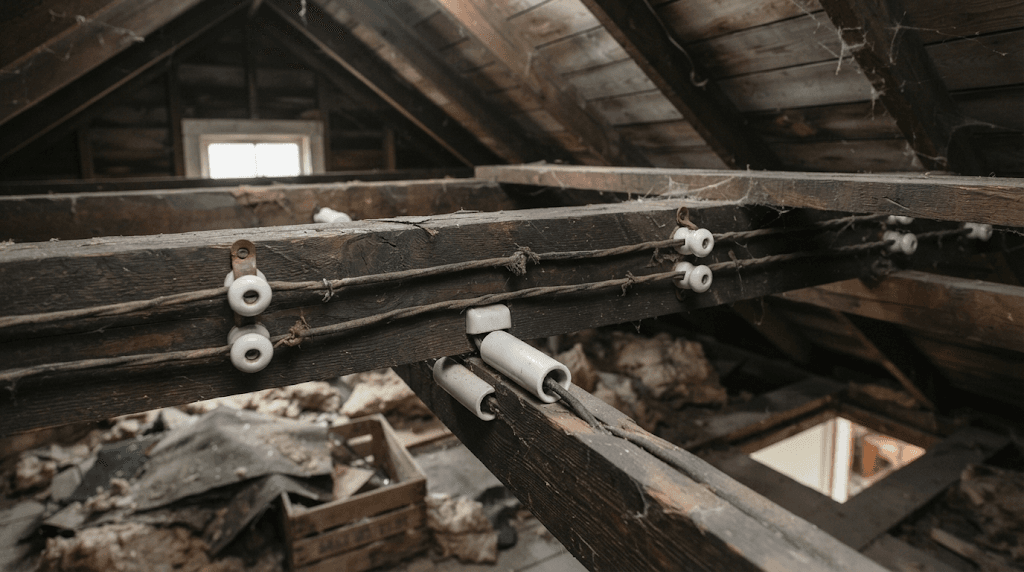
Knob and tube wiring was the standard residential electrical system in the United States from roughly the 1880s through the late 1940s. The name comes from its two components: ceramic knobs that hold the wires along joists and studs, and ceramic tubes that protect the wires where they pass through wood framing.
The system runs two separate conductors: a hot wire and a neutral wire, spaced apart through the home’s structure. What it doesn’t have is a ground wire. That third wire, the one that provides a safe path for fault current to travel back to the panel, didn’t become standard in residential wiring until modern systems replaced knob and tube in the 1950s and 1960s.
If you’re standing in an unfinished Memphis basement or attic and you see white ceramic spools nailed to the joists, with cloth-insulated wires looped underneath them, that’s knob and tube. Two-prong outlets throughout the house are another indicator, though a previous owner may have swapped in three-prong outlets without actually grounding the circuits, which creates its own set of problems.
How Much of Memphis Has It
Memphis built rapidly through the 1910s, 1920s, and 1930s. Midtown, Cooper-Young, Binghampton, South Memphis, Whitehaven, and older sections of Orange Mound have significant concentrations of pre-1950 housing. Many of those homes were wired with knob and tube and have never been fully rewired.
The tricky part is that most of these homes don’t look like they have knob and tube from the outside. A previous owner may have updated the visible portions, new outlets, a modern panel, without touching the original circuits running through the walls and ceiling. Older Memphis homes may still contain active knob-and-tube wiring even when visible electrical components have been updated. A newer breaker panel, modern outlets, or renovated rooms do not necessarily mean every original circuit has been replaced. The only reliable way to establish whether the system is still active is to have a qualified electrician inspect the accessible wiring and trace the relevant circuits. Canadian Underwriter, Managing Insurer Concerns About Knob and Tube Wiring
That’s not meant to scare anyone. It’s just useful to know before assuming your older Memphis home is clear.
Knob and Tube Wiring Risks: What Homeowners Should Know
Knob and tube wiring is not inherently dangerous the way it’s sometimes described. When it was installed correctly and left alone, it functioned reliably for decades. The problems that actually create fire risk aren’t really about the wiring method itself. They’re about what’s happened to the wiring since.
Insulation contact. Knob-and-tube wiring was designed to run with air space around its conductors to help dissipate heat. Adding insulation around active wiring can interfere with that heat dissipation and create a safety concern. Before insulating an attic or wall containing suspected knob-and-tube wiring, have a qualified electrician assess the system and confirm what corrective work may be necessary under applicable codes.
Improper splices. Every time someone tapped into the original knob and tube to add an outlet or extend a circuit, they introduced a connection point that may or may not have been done correctly. Open-air splices, wiring connections made without a proper junction box, show up in nearly every older home a licensed inspector examines. These fail over time.
Deteriorating insulation. The original cloth and rubber insulation on knob and tube wiring is, in the best cases, 70 to 100 years old. It becomes brittle and cracks. Where it’s been damaged by pests, moisture, or physical contact, it can leave bare copper exposed.
No ground. This one matters more than most homeowners realize. Without a ground wire, there’s no safe fault path. A surge, a short, or a wiring failure that a modern grounded system would redirect safely becomes a more unpredictable event in an ungrounded system.
Why Insurance Companies Are the Ones Forcing the Issue
Home insurers have been tightening their position on knob and tube wiring for years. Some surcharge policies for homes with active K&T. Others require an inspection and repairs before they’ll write or renew coverage.Some insurers may decline coverage when active knob-and-tube wiring is present, while others may require an inspection, repairs, or complete replacement. Requirements differ, so homeowners should obtain the specific conditions from their own insurer in writing. Insurance News Net, Knob and Tube Wiring Concerns: Safety and Insurance,
For Memphis homeowners, this comes up in three situations:
- Buying a home. If the home inspector flags knob and tube, your insurer may refuse to bind coverage or require the system be addressed before closing. No insurance means no mortgage in most cases.
- Selling a home. A buyer’s inspector finds K&T and the buyer’s insurance company won’t cover the home as-is. The sale stalls unless the seller addresses it or drops the price enough for the buyer to handle it post-closing.
- Renewing an existing policy. Some insurers are now doing periodic home inspections and discovering K&T in homes they’ve been covering for years. A renewal letter with a 60 or 90-day remediation requirement is what pushes most Memphis homeowners to finally call an electrician.
Knob and Tube Wiring Replacement Cost in Memphis
Replacing knob and tube wiring is not a small project. It involves accessing your home’s walls, ceiling cavities, and attic to remove or decommission the old runs and pull new grounded wiring throughout. Drywall or plaster gets opened, circuits get rewired to modern standards, and in most cases the electrical panel needs to be upgraded too, since the original 60-amp fuse boxes that came with K&T homes can’t support a modern load.
Here’s what the cost picture looks like for Memphis homes in 2026:
| Scope | Typical Cost Range | Notes |
|---|---|---|
| Partial replacement (a few circuits) | $2,000 to $8,000 | When K&T is limited to attic or accessible areas |
| Full rewire – small home (under 1,200 sq ft) | $8,000 to $14,000 | Includes labor, materials, outlets, switches |
| Full rewire – average home (1,200 to 2,000 sq ft) | $12,000 to $20,000 | Most common range for Memphis pre-1950 homes |
| Full rewire – larger home (2,000+ sq ft) | $18,000 to $35,000 | Increases with wall construction and access difficulty |
| Panel upgrade (usually required alongside rewire) | $1,500 to $4,000 | Most K&T homes still have 60-amp fuse boxes |
| Drywall repair (plaster homes cost more) | $1,000 to $5,000+ | Older Memphis homes with plaster walls add significant cost |
Cost ranges are sourced from Block Renovation’s 2026 K&T replacement cost guide and corroborated by national data from InchCalculator.
Two things drive the spread more than anything else. First, wall construction. A Memphis bungalow with original plaster walls costs considerably more to rewire than one that’s been renovated with standard drywall, because plaster is harder to open and patch. Second, access. When knob and tube runs through finished spaces that are difficult to reach without significant demolition, the labor time increases substantially.
Getting a licensed electrician to assess the scope before accepting any quote is the single best way to narrow that range for your specific home.
What the Rewiring Process Actually Looks Like
A full knob and tube rewiring job in a Memphis home typically spans two to five days depending on size and complexity. Here’s the sequence:
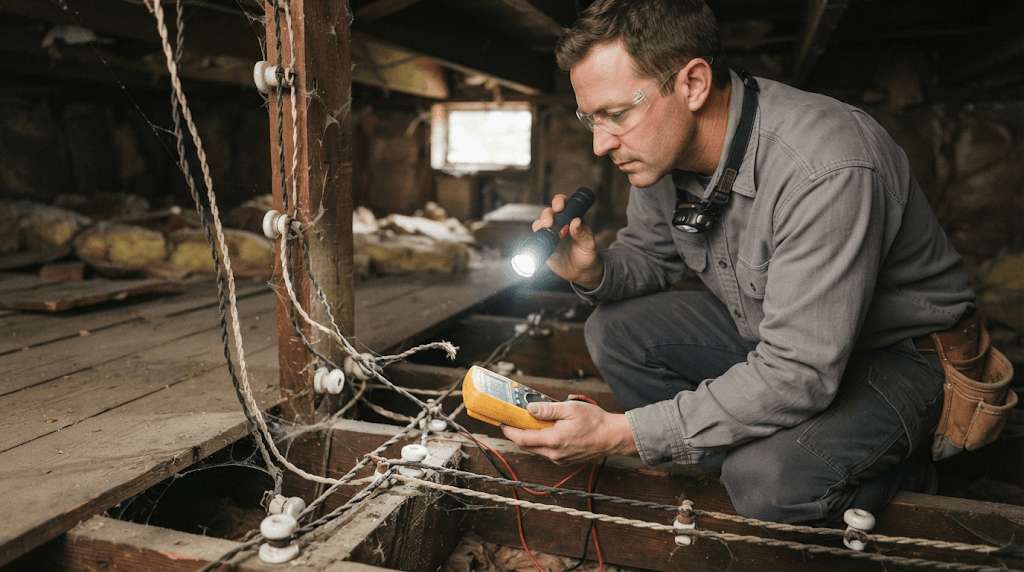
Inspection and scope definition. Before any work starts, a licensed electrician traces the existing knob and tube circuits, identifies which are still active, and documents what needs to be replaced versus what’s already been updated. This determines the scope and the quote.
Permit pull. Electrical rewiring in Shelby County requires a permit. A licensed contractor pulls it before work begins. If any electrician offers to skip the permit, that’s a firm reason to find a different contractor. An unpermitted rewire fails to satisfy insurance requirements and creates liability problems if you sell the house. You can verify Tennessee electrical contractor licensing through the Tennessee Board for Licensing Contractors.
Panel assessment. Most Memphis homes still running knob and tube also have the original 60-amp fuse-based panel. That panel needs to come out and be replaced with a modern breaker panel, typically 100 or 200 amps, before or alongside the rewiring. See our electrical panel upgrade cost guide for Memphis for what that adds to the project.
Circuit replacement. The electrician routes new grounded wiring through the home, opening walls and ceilings as needed, decommissioning the old K&T runs, and installing modern outlets and switches throughout. Each circuit gets connected to the new breaker panel.
Inspection. Shelby County requires a final inspection before the permit closes. The inspector verifies the work meets current NEC standards. This is not a formality, it’s the step that makes the work insurable and legally compliant.
Partial Replacement: When It’s Enough
Not every Memphis home with knob and tube wiring needs a full rewire. In some cases, only a portion of the original system is still active. A previous renovation may have already replaced the kitchen, bathroom, and main living circuits, leaving only the attic lighting or a secondary bedroom on the old wiring.
When a licensed electrician determines that the remaining K&T is limited and accessible, targeted replacement of those specific circuits can cost $2,000 to $8,000 and may satisfy an insurer’s requirements without a full-house project. The key word is “may”, some insurers require complete removal of all active K&T regardless of condition. Getting that requirement in writing from your insurance company before starting work avoids the situation where a partial replacement solves the electrical problem but doesn’t resolve the insurance issue.
What to Tell Your Insurance Company
If you’ve been flagged for knob and tube wiring and you’re trying to figure out the right sequence of steps:
- Get the insurer’s specific requirement in writing. “Address the knob and tube wiring” is not specific enough to act on. Ask whether partial replacement satisfies them or whether complete removal of all active K&T is required.
- Get an electrical inspection from a licensed Memphis electrician before committing to a scope of work. Some homes need less than the worst-case quote suggests.
- Ask whether a licensed electrician’s written assessment and repair plan, provided before the work is completed, buys time with your insurer while the project is being scheduled.
- Once work is done and the permit inspection is passed, request documentation from the electrician to send to your insurer. That paperwork is what actually clears the insurance issue.
Does Replacing Knob and Tube Add Value to a Memphis Home?
It does, though the math isn’t always straightforward. A full rewire and panel upgrade doesn’t typically show up as a line item that buyers pay a premium for. What it does is remove a disqualifying factor. A Memphis home with active knob and tube wiring either won’t sell to a buyer using conventional financing, or will sell at a discount that reflects the cost of remediation.
Eliminating that obstacle, getting the home insurable at standard rates, and allowing a buyer to finance normally is where the value shows up. For older Memphis homes in Cooper-Young, Midtown, and Binghampton where the housing stock is pre-1950 and buyers expect some issues, being able to market a home with updated wiring and a modern panel is a real competitive advantage. Block Renovation, How Knob and Tube Affects Resale Value
Frequently Asked Questions
Is knob and tube wiring illegal in Memphis?
No. Existing knob and tube wiring is not automatically illegal under Tennessee’s adoption of the National Electrical Code. It cannot be extended or added to, and new installations are prohibited, but the presence of old K&T in a home isn’t a code violation by itself. The issue is insurability and safety condition, not legality.
Can I add insulation to my Memphis attic if I have knob and tube wiring?
Not safely, and not legally without addressing the wiring first. Blowing insulation over active knob and tube is a documented fire risk, the system was designed to dissipate heat into open air. Most insulation contractors will flag this before they start work, and some will decline the job entirely until the electrical is addressed.
How do I know if my Memphis home has knob and tube wiring?
Check your basement ceiling, attic, or any exposed framing you can access. You’re looking for ceramic spool-shaped knobs nailed to joists or studs, with cloth-wrapped wires looped beneath them, and ceramic tubes where wires pass through wood. Two-prong outlets throughout the house are a secondary indicator, though not conclusive. A licensed electrician can do a full assessment if you’re unsure.
My home has been rewired in some areas. do I still have a problem?
Possibly. Partial rewires are common in older Memphis homes. A previous owner may have updated the kitchen, bathrooms, and main circuits while leaving the original K&T in place for secondary bedrooms, hallway lighting, or attic circuits. Only a full inspection determines what’s actually still active. An electrician who tells you the home is clear without physically tracing the circuits isn’t doing a thorough job.
Will my insurance company accept a partial replacement?
It depends on your specific insurer and their written requirements. Some will accept targeted replacement of remaining active K&T circuits. Others require complete removal regardless of how much original wiring remains. Get their requirement in writing before you start any work.
How long does a full knob and tube rewire take in Memphis?
Most single-family Memphis homes take two to five days, depending on size, wall construction, and how much of the original system needs to be replaced. Plaster-wall homes and multi-story properties take longer and cost more due to the added difficulty of access
Bottom Line
Knob and tube wiring is one of those issues that Memphis homeowners in older neighborhoods encounter regularly, usually at the worst possible moment, a sale falling through, an insurance renewal getting complicated, or a home inspection turning up something nobody expected. The wiring itself isn’t necessarily failing, but the combination of age, no ground wire, and the real risks created by improper modifications and insulation contact make it something worth addressing rather than hoping the next owner inherits.
Replacement is not cheap. For a typical pre-1950 Memphis home, a full rewire with a panel upgrade runs $14,000 to $24,000. But it’s a defined project with a clear endpoint, and it removes a problem that otherwise follows the house through every future sale and every insurance renewal.
If you have a pre-1950 home in Memphis, Germantown, Collierville, Bartlett, or anywhere in Shelby County and want to understand exactly what you have before committing to a scope of work, Ace Electric offers electrical inspections and free estimates. We’ve been doing this work in Memphis since 1986 and we’ll tell you what’s actually there rather than what’s easiest to quote. Call (901) 870-3298 or visit electricmemphis.com to schedule.
For related reading on Memphis electrical work, see our guides on how much it costs to rewire a house in Memphis, electrical panel upgrade costs, and whole-home surge protection.
Ace Electric serves Memphis, Germantown, Cordova, Bartlett, Collierville, and surrounding Shelby County communities. Licensed, insured, and locally operated.